What to buy for a newborn before delivery: the complete shopping checklist
Almost every first-time parent buys too much, in the wrong sizes, too early. This is the list that accounts for the things Indian families actually experience — the gifts that arrive uninvited, the sizes that mean nothing, and the handful of popular items you should not buy at all.
- Third trimester
- Newborn essentials
- Checklists
- First-time parents
Listen to this guide
23 minutes · 13 chapters
Introduction
Chapter 1 of 13
Read by a synthetic voice from the text of this article. Nothing is said in the audio that is not written above.
The short version
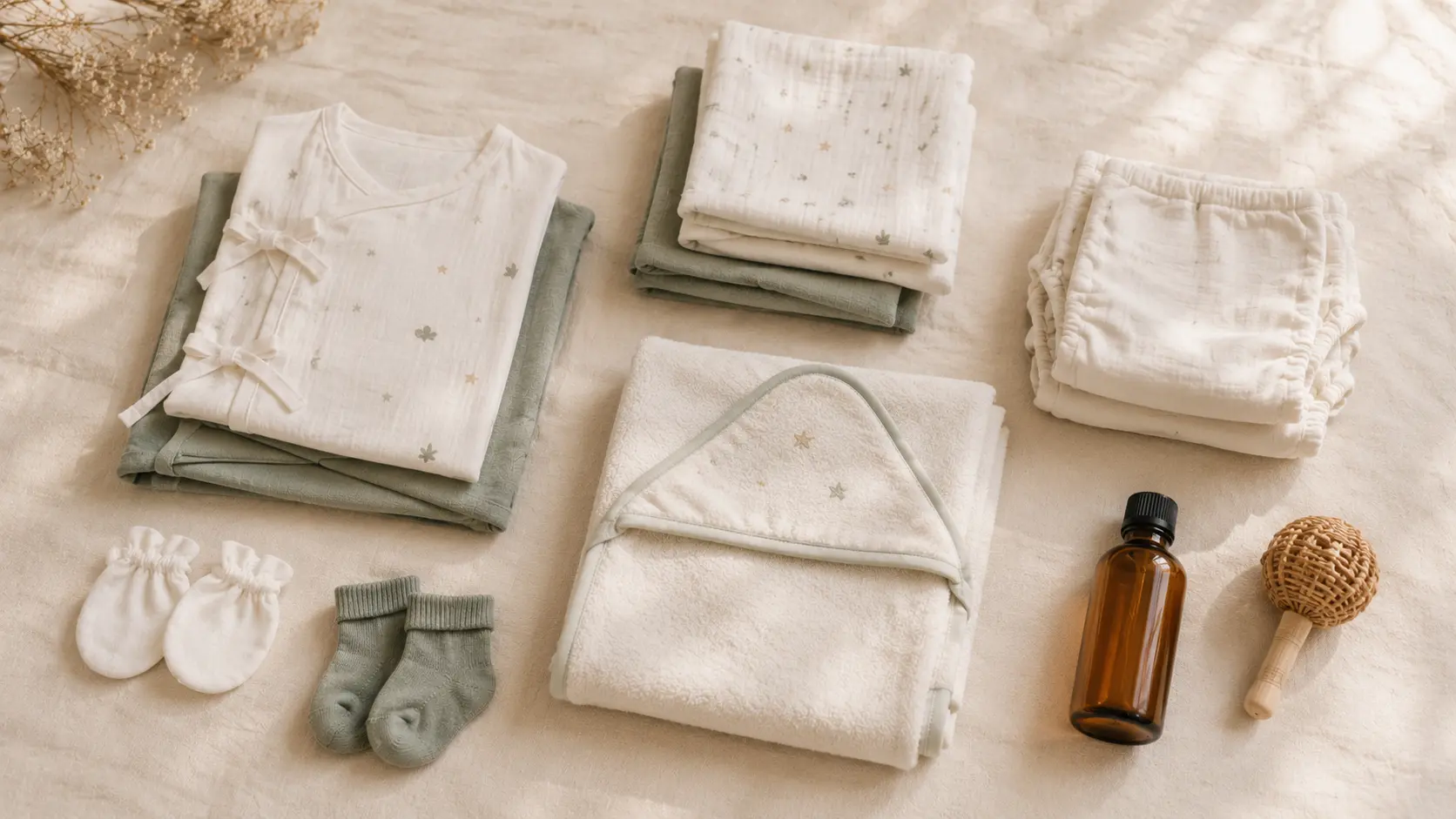
- Buy about half of what any shopping list tells you. Relatives, colleagues and neighbours will arrive with clothes, and most of it will be 0–3 months.
- Six to eight newborn outfits is enough to start. Wash everything before it touches the baby — new fabric is stiff and carries factory sizing chemicals.
- Do not buy newborn clothes in bulk in one size. Babies grow through the first sizes in weeks, and Indian sizing is inconsistent between brands.
- Skip entirely: kajal and surma, walkers, cot bumpers, pillows, and gripe water. Each is still widely sold or recommended here, and each carries a real risk.
- Feeding equipment can wait. If you plan to breastfeed, buy bottles and a pump only if and when you actually need them.
- Buy before week 36, and keep the receipts. Anything unopened can go back once you know what your baby is actually like.
Start by buying about half of what the lists tell you
Every newborn shopping list you find is longer than it needs to be. Some of that is honest enthusiasm and some of it is that shopping lists are written by people who sell things. Either way, the result is the same: a cupboard of unworn 0–3 month clothes and a steriliser still in its box.
There is a second reason particular to families here. In most Indian households a new baby arrives into a stream of visitors, and a great many of them bring clothes. Grandparents, aunts, your husband's colleagues, neighbours you have met twice. Almost all of it will be 0–3 months, because that is what looks smallest and sweetest in the shop.
So the sensible approach is to buy the minimum that gets you through the first two weeks, keep the receipts, and fill the gaps once you can see what has arrived and what your baby is actually like.
When should you buy it all?
Aim to have the essentials home and washed by the end of week 36. That is late enough to know roughly how the pregnancy is going, and early enough that an early arrival does not catch you with an empty cupboard.
If your family observes a custom of not bringing baby things into the house before the birth — and many do — the practical version is to buy the essentials, keep them at a relative's home or unopened in their bags, and have one person whose job it is to bring them over. What you want to avoid is somebody shopping from a hospital car park.
Clothes: how many, and which kind
This is where most of the over-buying happens, and where the advice written abroad fits worst.
Jhablas before onesies, at least at first
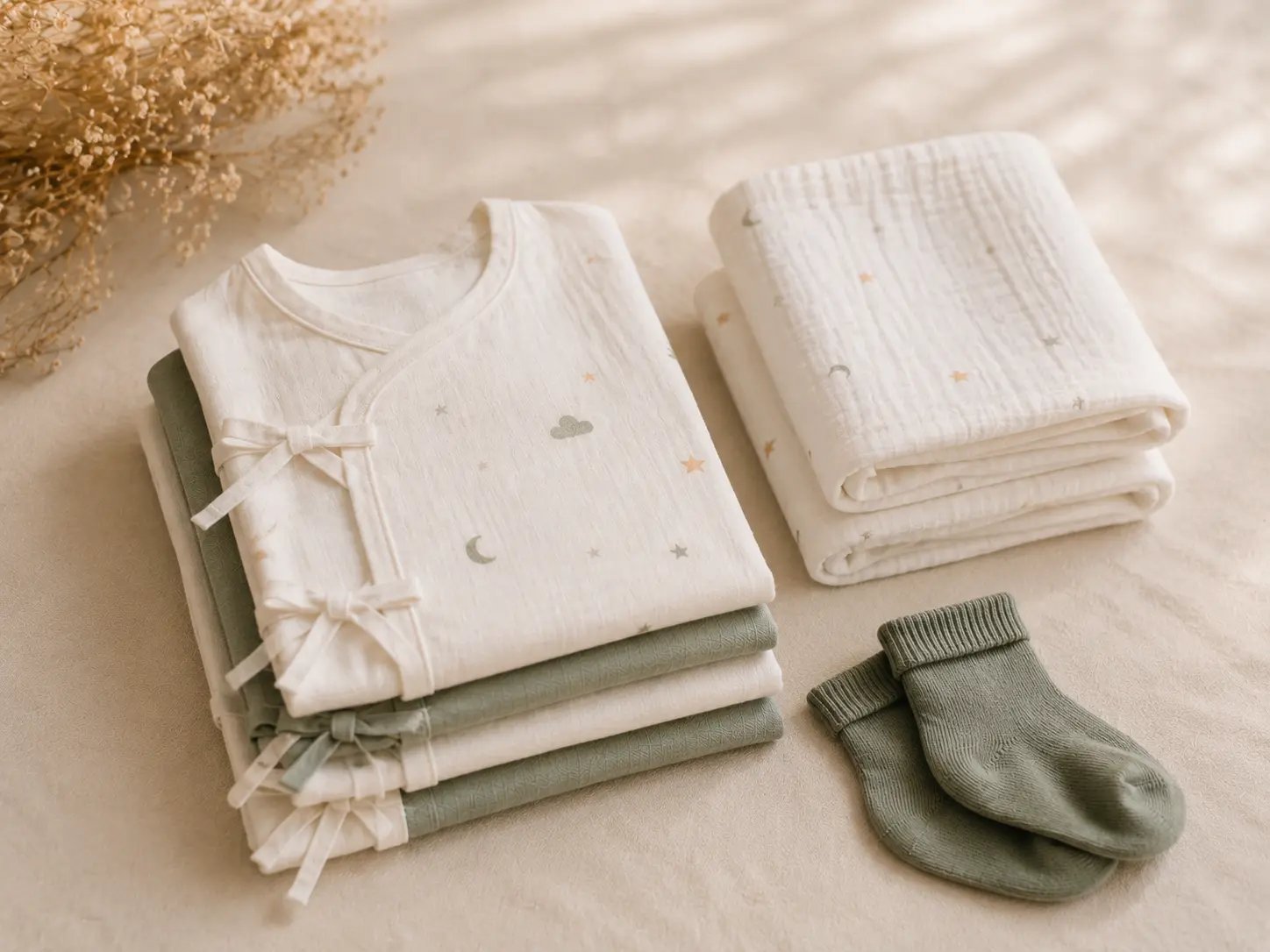
A jhabla — the soft cotton top that ties at the side rather than pulling over the head — is genuinely better for a newborn than a step-in onesie, and it is the one piece of traditional Indian baby clothing that has no better modern replacement. Nothing goes over the baby's face, nothing has to be pulled past a soft head, and it opens flat for a nappy change or a massage.
Onesies and step-in suits come into their own around the second month, when the baby has more neck control and you are outdoors more.
How many of each
| Item | Buy before birth | Why not more |
|---|---|---|
| Newborn jhablas / vests | 6–8 | Two or three changes a day is normal, and you will be washing daily anyway. |
| Sleepsuits or step-in onesies | 2–3 | Most of your gifts will be these. Wait and see what arrives. |
| Muslin cloths | 6–8 | The one thing nobody regrets buying. Burp cloth, sun shade, swaddle, wipe. |
| Swaddle wraps | 2–3 | A large muslin does the same job for less. |
| Mittens and socks | 3–4 pairs | They get lost constantly. Buy cheap, buy a few. |
| Caps | 2 | One on, one in the wash. |
| Cardigan or light jacket | 1–2 | Season-dependent, and easily bought later. |
Two things about size. First, newborn sizing is not standard across Indian brands, and a 0–3 from one shop can be visibly larger than a 0–3 from another. Second, plenty of babies never fit newborn size at all, or leave it inside three weeks. Buy a small number in newborn, a few in 3–6 months, and fill in later.
Wash everything before it touches the baby, in a mild detergent and separately from the household wash. New fabric is stiff, and it carries sizing and finishing chemicals from the factory.
Feeding: buy almost nothing yet
If you are planning to breastfeed, the honest answer is that you need very little equipment and none of it urgently. Buying a full set of bottles, a steriliser and a pump before the birth is the single most common way to spend a lot of money on things that stay in their boxes.
- Nursing bras — 2 to 3, bought late in pregnancy and a size up, because your size changes when your milk comes in.
- Nursing pads. Buy one pack to start and see how you get on with them.
- A feeding pillow, if you want one. Useful, not essential, and a firm cushion does much of the same job.
- Nipple cream. Cheap, and you will be glad it is already in the house rather than something someone has to go out for.
- A large water bottle for you. Feeding makes you thirsty in a way nobody warns you about.
Bottles, a steriliser and a pump are worth buying when you know you need them — if you are going back to work, if feeding is not going smoothly, or if your doctor advises it. That decision is usually clear within the first fortnight, and everything is available within a day.
Nappies and changing
Newborns get through eight to twelve nappies a day in the early weeks. That number frightens people into bulk-buying, which is the wrong response — buy one pack of newborn size and see how your baby is built before committing.
- Disposable nappies, newborn size — one pack. Not size 1, and not a carton.
- Cloth nappies or langots, if you plan to use them — 12 to 15, since they need washing and drying time. Many families here use cloth by day and disposables at night, which is a reasonable middle path.
- Cotton wool and a bowl for warm water. Plain cotton and water is what most pediatricians prefer for the first weeks over wipes.
- One pack of fragrance-free wipes, for when you are out.
- A barrier cream for nappy rash. One tube.
- A changing mat, or simply a folded towel with a waterproof sheet under it.
You do not need a changing table. A firm surface at a height that does not hurt your back is the entire requirement, and in most Indian homes that is a bed with a mat on it.
Sleep
The safest sleep setup is also the cheapest: a firm, flat surface with a fitted sheet and nothing else in it. No pillow, no quilt, no bumpers, no soft toys.
- A cot, a crib, or a traditional cloth jhula — whichever suits your home, as long as the surface is firm and flat and it meets current safety standards.
- A firm mattress that fits the frame with no gap at the edges.
- Two or three fitted sheets, so there is always a clean one during a night change.
- A sleeping bag or swaddle, rather than loose blankets.
- A mosquito net, sized to the cot rather than draped over it.
Where the baby sleeps in the first months is a decision to make with your pediatrician rather than from a shopping list. What is not negotiable is the surface: firm, flat, and empty.
Bathing, massage and skin
A newborn does not need a daily bath with soap, and needs very little product of any kind. Most of what is sold for newborn skin exists because it can be sold.
- A baby bath tub, or a wide plastic tub. The traditional approach of bathing the baby across your legs works too, and many caregivers prefer it.
- Two hooded towels, and two soft washcloths.
- A mild, fragrance-free cleanser — used sparingly, and not necessarily every day.
- Massage oil. Cold-pressed sesame or coconut are the usual choices, and your pediatrician's view on which is the one that counts. Buy a small bottle first and watch for any reaction on a small patch of skin.
- A soft brush and a blunt-tipped nail file. Not scissors.
- A digital thermometer.
Talcum powder is worth a specific mention because it is still a default gift here. Loose powder near a newborn's face can be inhaled, and it is no longer recommended for babies. If you receive some, it does not need to be used.
What not to buy — even though it will be recommended
This is the shortest section and the most useful one. Each of these is sold in Indian baby shops or handed on as standard advice, and each is worth declining politely.
| Do not buy | Why |
|---|---|
| Kajal or surma for the eyes | Traditional, affectionately meant, and a documented source of lead exposure in Indian infants. It does not protect the eyes or improve eyesight. |
| Baby walkers | Associated with serious falls, banned outright in Canada, and advised against by pediatric bodies including in India. They do not help a baby learn to walk. |
| Cot bumpers and soft toys in the cot | Suffocation and entanglement risk. A cot should be firm, flat and empty. |
| Pillows for a newborn | Including the moulded 'head-shaping' ones. Not recommended for babies under one. |
| Gripe water and colic drops | Widely given here, unregulated in composition, and not evidence-based. Speak to your pediatrician about a baby who cries inconsolably rather than treating it yourself. |
| Honey, on the dummy or otherwise | Never before one year — a genuine risk of infant botulism, regardless of how the honey is sourced. |
| A full bottle-feeding kit, in advance | Not a safety issue, just money. Buy it if and when feeding actually calls for it. |
What can wait until after the baby arrives
None of this is a mistake to own. It is a mistake to own it in week 34, before you know whether you will use it.
- A pram or stroller. You will be carrying the baby for the first months, and the model you want depends on where you actually walk.
- A high chair, a playmat, toys. Months away.
- A breast pump, unless your doctor has already told you that you will need one.
- A steriliser. If you end up needing one, it arrives the next day.
- A nappy bag. Any bag works until you know what you carry.
- Clothes beyond 3–6 months. Your relatives have this covered, and then some.
A car seat is the one exception on this list. If you will bring your baby home by car, that is needed on day one, not later.
The complete newborn shopping checklist
Tick items off as you buy them. Your ticks are saved on this device, so you can come back to it — nothing is sent to us.
0 / 40
Clothes
0/9Buy the low end of every range. Gifts will fill the rest, and they will almost all be 0–3 months.
Feeding
0/5If you plan to breastfeed, this is genuinely most of what you need.
Nappies and changing
0/6Sleep
0/5Firm, flat and empty. That is the whole safety rule.
Bathing, massage and skin
0/6Needed on day one
0/3Deliberately not buying
0/6Tick these to confirm you have decided against them, not to buy them.
The one thing that is not on any shopping list
It is easy to spend the third trimester shopping, because shopping feels like preparation and is something you can finish. The harder preparation has no cart: who will cook in the first fortnight, who will answer the door, who will show you how to bathe a slippery newborn the first few times, and who is paying attention to your own recovery rather than only the baby's needs.
That role traditionally had a person attached to it — the grandmother who moved in for forty days, the japa maid, the malish wali who came each morning. Deciding early what fills it is worth more than anything in a cupboard.
This is a practical shopping guide, not medical advice. The safety notes reflect current pediatric guidance, but your own pediatrician knows your baby and their instructions always take precedence over anything here.